
This is a temporary website. The official website of the Centre for Ius Commune is currently under construction.
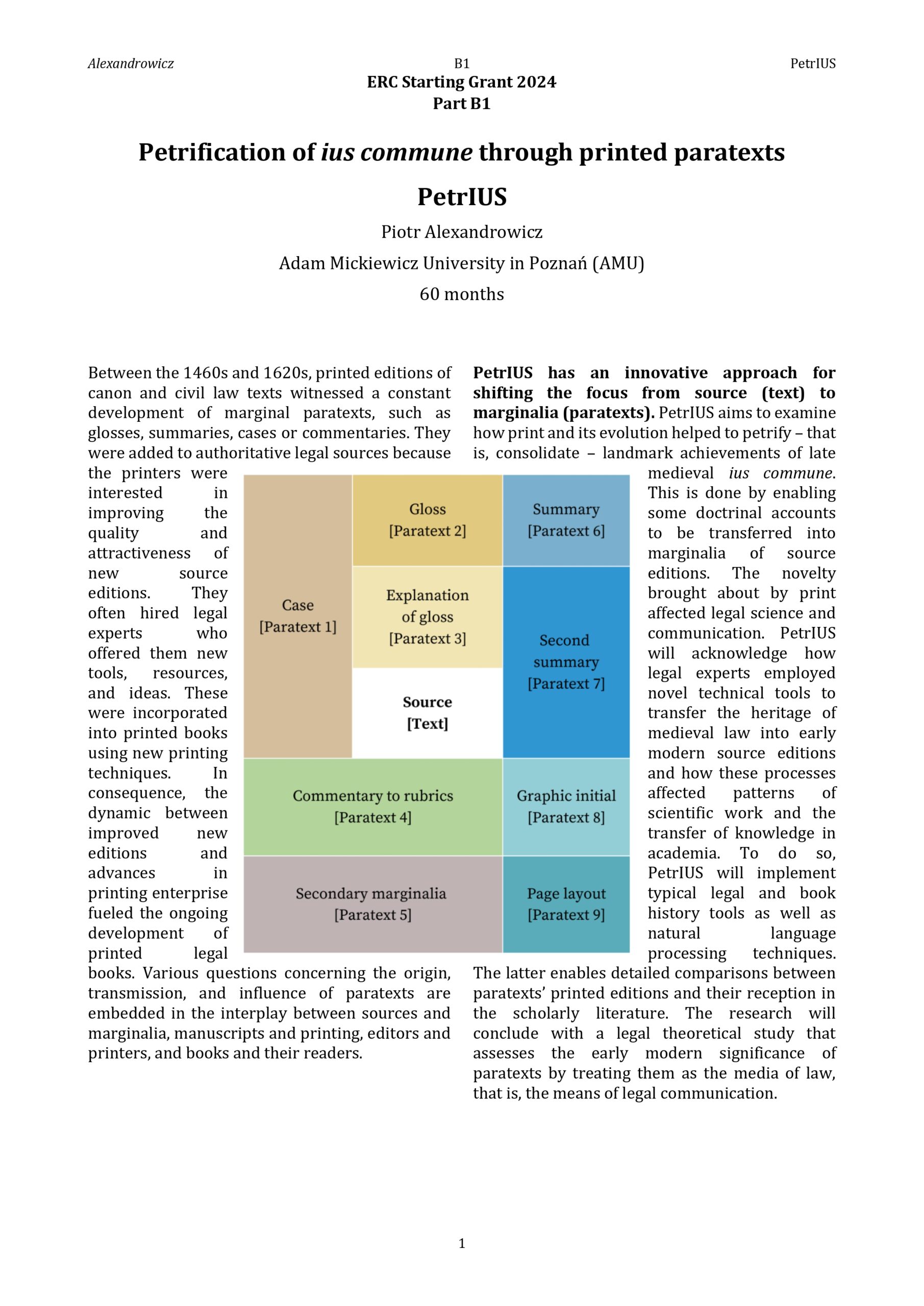
PetrIUS: Petrification of ius commune through printed paratexts is an ERC Starting Grant led by Piotr Alexandrowicz and implemented at the Centre for Ius Commune, established for the purposes of this project. The Centre is hosted by the Faculty of Law and Administration at Adam Mickiewicz University, Poznań (Collegium Rubrum, Room 112, al. Niepodległości 53, 61-714 Poznań). Grant Agreement number is 101162091.
For more information about PetrIUS, please scroll to the bottom of the page.
The team currently consists of three members:
Principal Investigator: Dr Piotr Alexandrowicz
Postdoctoral Researcher: Dr Matthew Cleary
Project Manager: Karolina Pełka-Gawlik
We are joined in legal history research on ius commune by Dr Marco Castelli and Maria Kola.
7-8.09.2026: Seminar on Legal Commentaries
The seminar „Legal Commentaries: Between History and Theory” will take place at Adam Mickiewicz University in Poznań on 7–8 September 2026. Bringing together legal historians, canon law scholars, and legal theorists, the seminar will examine legal commentary as a historical form, an interpretative practice, and a contemporary legal genre. The contributions will range from early modern manuscript and print traditions to modern code commentaries, case-law commentaries, and analytical legal philosophy. The seminar is organised within the NCN-funded SONATA 18 project “EXTRA: The Decretals, Early Modern Science of Canon Law and Legal Commentaries Today”.
Below you can find the programme and the book of abstracts.

4.08.2026: SONATINA 10 grant awarded
Marco Castelli has been awarded a SONATINA 10 grant by the National Science Centre of Poland (NCN) for the project Ius Commune Venetum: Normative Identities and Legal Pluralism in the Venetian Terraferma (16th–18th Centuries) (reg. no. 2026/60/C/HS5/00195). He will continue his work with the Centre as an affiliated member.
The project takes the Republic of Venice as a case study in early modern composite statehood. Rather than imposing a single unified code on its mainland territories, Venice allowed local communities to keep their own municipal statutes while retaining control through a central supreme court. By reconstructing complete civil cases from the records of that court and cross-referencing them with local statutory law, the research asks how judges, litigants and local elites actually resolved the contradictions between local tradition and central authority – and how such a system could hold together while remaining diverse.
The grant runs for 36 months and includes research stays in Padua, Venice and Frankfurt. It continues his work on the boundaries of the ius commune, building directly on the archival campaign carried out in Venice earlier this year under the NCN MINIATURA 9 scheme.
Here’s the general description of the research: https://ncn.gov.pl/sites/default/files/listy-rankingowe/2026-08-03-sonTuiKo92zcv/streszczenia/669862-en.pdf


Workshop: Rare Book and Manuscript Cataloguing
Matthew completed a two-week intensive summer course in Rare Book and Manuscript Cataloguing at Massey College, University of Toronto. This was an extremely valuable opportunity to refine practical cataloguing skills directly relevant to the PetrIUS project and our work with early printed books.

PetrIUS: Three Postdoctoral Calls
The Centre is seeking three Postdoctoral Researchers for the ERC Starting Grant project PetrIUS. We invite applications from researchers interested in early modern legal history, book history, and digital humanities. The Centre hosts various research projects related to early modern ius commune, including projects on early modern commentaries on the Decretals, law in early modern Venice, early modern scholasticism and law, and the incunabula of the (in)famous Hammer of Witches. We cooperate with numerous scholars and research groups across Europe.
All three positions are full-time appointments for 36 months (including a six-month probation period), starting in December 2026 (or slightly later). The application deadline is 30 September 2026. Further details are available via the links below.
For further information about the calls or the project, please do not hesitate to contact us!
Postdoc 2: Legal History
This researcher will work on the work packages Investigation of Paratexts’ Origins and Variants and Research on Paratexts Forming Part of the Printed Corpora Iuris. Candidates must hold a PhD in the humanities or social sciences (preferably in legal history), obtained no later than the commencement of employment, and demonstrate a strong interest in the history of law in the late medieval and early modern periods, particularly the history of ius commune and legal books.
More information: https://bip.amu.edu.pl/konkursy-zatrudnienie-w-projektach-badawczych/konkurs_post-doc_2_petrius_centrum-ius-commune
Postdoc 3: Book History
This researcher will work on the work packages Investigation of Paratexts’ Origins and Variants and Research on Paratexts Forming Part of the Printed Corpora Iuris. Candidates must hold a PhD in the humanities or social sciences (preferably in book history), obtained no later than the commencement of employment, and demonstrate a strong interest in the history of books in the late medieval and early modern periods, particularly legal books.
More information: https://bip.amu.edu.pl/konkursy-zatrudnienie-w-projektach-badawczych/konkurs_post-doc_petrius_centrum-ius-commune2
Postdoc 4: Digital Humanities
This researcher will work on the work package Large-Scale Research on Paratext Variants and Their Use in Scholarly Literature. Candidates must hold a PhD in the humanities, social sciences, information technology, or another relevant discipline (preferably digital humanities), obtained no later than the commencement of employment. Applicants should demonstrate an interest in digital humanities through previous research and publications. Candidates are expected to possess knowledge of research methods and tools necessary for the implementation of the project’s tasks, including natural language processing, machine learning (including deep learning), and programming languages. Familiarity with topics related to the project’s subject matter, such as legal history, book history, or literary theory, will be considered an advantage.
More information: https://bip.amu.edu.pl/konkursy-zatrudnienie-w-projektach-badawczych/konkurs_post-doc_4_petrius_centrum-ius-commune
7.2026: Papers in the UK
Matthew travelled to the United Kingdom to present two papers:
“Hugo Grotius’s De iure belli ac pacis in Britain” at the British Legal History Conference in Nottingham.
“Old Enough to Marry? Age, Memory, and Delay in York Cause Paper E 23, 1332–33” at the International Medieval Congress in Leeds (earlier presented at a seminar for the Centre for Ius Commune).

Archival research in Venice – June 2026
In early June, Marco spent a week of archival research at the State Archives of Venice, working on the relationship between Venetian law and the ius commune in the seventeenth century.
The visit was funded by the National Science Centre of Poland (NCN) under the MINIATURA 9 scheme, for the project Ius Commune Venetum: Regulatory Void Between Case Law and Written Law Traditions in Early Modern Venice. The project asks how the Venetian legal order dealt with the gaps in its own written law, and what room this left for the learned legal tradition and for judicial practice. The documentation collected in Venice will support the next stage of the research.

Herzog August Bibliothek Fellowship
From May to June, Matthew held a two-month fellowship at the Herzog August Bibliothek in Wolfenbüttel, where he studied the early reception of the Malleus Maleficarum and early printed editions of the Institutiones. The fellowship provided an invaluable opportunity to examine surviving copies closely and to explore evidence of their ownership, annotation, and use.

Integration at the Centre
Over the course of the last year, we have had multiple opportunities to spend time together, whether over lunch in the staff kitchen, outings for pizza or pasta, barbecue, or birthday celebrations. While these activities are not directly related to research, they are an important part of our day-to-day teamwork and help strengthen collaboration within the team.


Funding for the research on Malleus Maleficarum
In July, Matthew won a small grant from the National Science Centre Poland’s MINIATURA 10 funding scheme [2026/10/X/HS5/00457; „The Legacy of the Malleus Maleficarum: The Legal Reception of the Malleus Maleficarum in early printed editions (1486–1496)”]. The award will support a pilot study involving three weeks of research in Sweden, where he will examine surviving copies of the Malleus Maleficarum and the evidence they preserve of ownership, use, and legal reception.
See more in Polish here: https://prawo.amu.edu.pl/aktualnosci/finansowanie-z-ncn-dla-historykow-prawa/
24.06.2026: Second Seminar at the Centre
On Wednesday, 24 June 2026, Matthew Cleary presented a paper entitled Old Enough to Marry? Age, Memory, and Delay in York Cause Paper E 23, 1332–33.

New book chapter with Viella – May 2026
A new chapter by Marco has been published in Dal diritto della salute al diritto alla salute. Storia, istituzioni, problemi della sanità in Italia tra Otto e Novecento, edited by Luigi Lacchè (Rome).
The contribution, “I due rami essenziali”: la collocazione del servizio pubblico veterinario tra tutela della salute pubblica e sostegno della produzione (pp. 243–258), reconstructs how the Italian public veterinary service came to be positioned between two competing purposes: safeguarding public health on the one hand, and supporting agricultural and livestock production on the other.
The chapter is a shorter version of a longer study on the Italian model of veterinary services and the building of the system of the Istituti Zooprofilattici Sperimentali, published in Rivista di diritto agrario, CIV-4 (2025), pp. 473–507.

Publication: Looting, Ownership, and Annotations: Early Readers’ Engagement with Hugo Grotius’s De iure belli ac pacis
Matthew published a book chapter (with Mark Somos): “Looting, Ownership, and Annotations: Early Readers’ Engagement with Hugo Grotius’s De iure belli ac pacis,” in Loot & Repair: Plunder and Restitution between the Early Modern Battlefield and the Modern-Day Museum (Officina Libraria), edited by Francesca Borgo and Julia Vázquez.
https://www.officinalibraria.net/libro/9788833673592
16.04.2026: Matthew in Fribourg
In April, Matthew presented The Eloquence of Law: Humanist Rhetoric and Italian Paratexts of the Corpus iuris civilis (c. 1470–1627) at the workshop Diritto e letteratura in Italia tra Medioevo e Rinascimento (secc. XII–XVI): testi, contesti, transiti, held at the University of Fribourg in Switzerland. The event was organized by Ludovica Quartiroli, Ignazio Alessi, and Gavino Scala.

Daily Work at the Centre ;-)


5.03.2026 Invited lecture at Saint Louis University
On 4 March 2026, Marco Castelli gave an invited lecture at the Center for Medieval and Renaissance Studies of Saint Louis University, entitled Legalizing the Exception: The Miracle as a Paradigm for Sovereign Power in the 13th Century.
The lecture, delivered as part of his NEH Research Fellowship at the Center, examined how thirteenth-century thinking about the miracle – an event that suspends the ordinary order of nature without abolishing it – offered medieval jurists and theologians a way of conceptualising the sovereign power to depart from the law.

26-27.03.2026: Presentation at Collège de France
Piotr Alexandrowicz was invited to participate in the seminar hosted at the Collège de France by Prof. Dario Mantovani. The seminar, In Margine. The Philology of Paratexts and Its Implications: Law, Literature, Religion, was coordinated by Prof. Francesca P. Barone and Prof. Arnaud Perrot (link). Piotr’s presentation focused once again on printed paratexts in canon law texts, this time offering an overview of the current state of research, the principal types of paratexts, and promising directions for future scholarship. The recording of this lecture is provided here.
In the first photograph Piotr is joined by the conveners, while in the second photograph, he is pictured with Prof. Xavier Prévost, a member of the PetrIUS Advisory Board.


Publication: Exploring Legal and Linguistic Dimensions in Late Medieval English Jurisprudence: William Lyndwood’s Provinciale and Inheritance Practices
Matthew published a book chapter: “Exploring Legal and Linguistic Dimensions in Late Medieval English Jurisprudence: William Lyndwood’s Provinciale and Inheritance Practices,” in Law and Literature: An Interdisciplinary Exploration of Medieval Texts (Brepols), edited by Ignazio Alessi and Gavino Scala. https://www.brepols.net/products/IS-9782503620343-1
NEH Research Fellowship at Saint Louis University – January to March 2026
Between January and March, Marco Castelli was in residence at the Center for Medieval and Renaissance Studies of Saint Louis University as the holder of an NEH Research Fellowship, awarded by the Center with the support of the National Endowment for the Humanities.
The fellowship supports research in the University’s collections, including the Vatican Film Library and the manuscript and rare book holdings of the Pius XII Memorial Library. His stay was devoted to the relationship between physics, theology and law in the thirteenth century, with a view to reworking his doctoral dissertation for publication.

27-28.02.2026: Cluj-Napoca Workshop

Piotr Alexandrowicz delivered an invited keynote lecture at the workshop Paratextual Elements: Tables, Indexes, Marginal Notes, Diagrams, etc., organised by Alexandra Băneanu in Cluj-Napoca (link). His presentation provided a general overview of printed paratexts in editions of canon law texts.
24.02.2026: First Seminar at the Centre
In the first meeting Piotr Alexandrowicz spoke in general about the project and the first observations on the development of canon law printed paratexts. The hybrid meeting took place on Tuesday, 24.02.2026 at 11 am CEST.
Publication: 'What Makes a Legal Commentary? Louvain Professors on Liber extra and Liber
sextus’
Piotr Alexandrowicz, ‘What Makes a Legal Commentary? Louvain Professors on Liber extra and Liber
sextus’ in V. Soen, W. Druwé, W. François, R. Dekoninck (eds), Innovationes
Lovanienses: Crossroads of Knowledge Transfer between Antiquity, Middle Ages, and
Renaissance (Turnhout: Brepols 2025)
https://www.brepolsonline.net/content/books/10.1484/M.LECTIO-EB.5.152281
15-16.01.2026: Toledo Workshop

Matthew and Piotr took part in a workshop in Toledo organized by the Max Planck Partner Group The Production of Knowledge of Normativity and the Early Modern Book Trade, hosted at the Max Planck Institute for Legal History and Legal Theory and led by Manuela Bragagnolo (link). During the group’s third workshop, Piotr presented a paper entitled From the Margins to the Centre: A Visual Journey of Summaries in Early Modern Canon Law Books.
1.01.2026: Matthew Cleary Joins the Team!
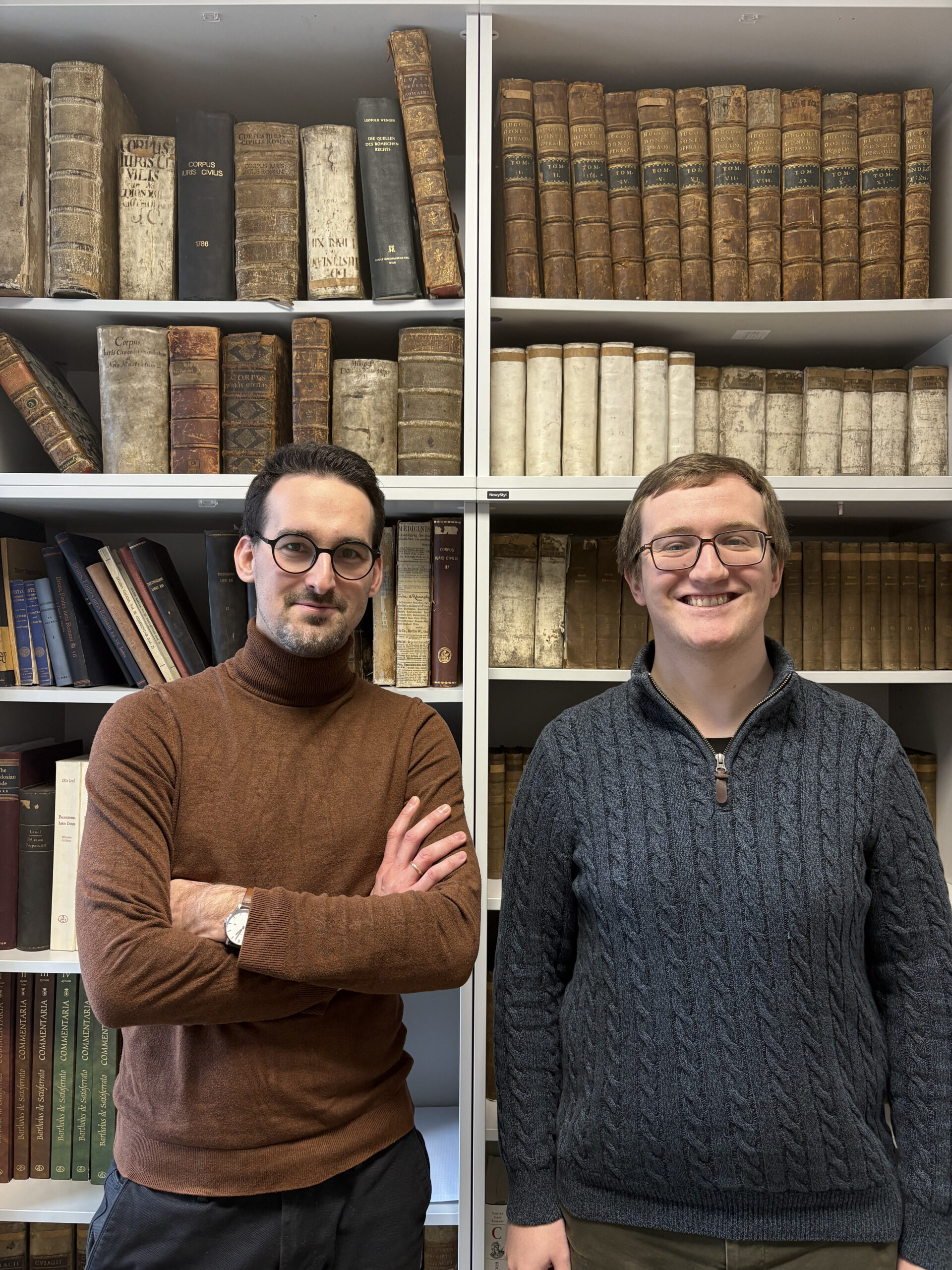
With the start of the new year, the PetrIUS team has grown with the appointment of Matthew Cleary as the project’s first postdoctoral researcher. Matthew earned his PhD in Edinburgh and spent the last two years working on the Grotius Census project in Heidelberg. His expertise spans both legal history and the history of the book, making him ideally suited to the research he will undertake within PetrIUS on the printed legal paratexts of the Corpus Iuris Civilis. Later this year, we will be recruiting three additional postdoctoral researchers.
17.11.2025: Talk at the ERC Workshop
Piotr spoke about his experience of preparing an ERC application at the ERC Workshop in Warsaw, which was organised for prospective applicants seeking ERC funding.
https://www.kpk.gov.pl/wydarzenia/warsztaty-dla-aplikujacych-o-granty-erc

Publication: ‘Does Truth Fear No Scandal? On the regulae iuris and the Legal Commentaries in
Canon Law (12th–17th Centuries)’
Piotr Alexandrowicz, ‘Does Truth Fear No Scandal? On the regulae iuris and the Legal Commentaries in
Canon Law (12th–17th Centuries)’ in I.A. Kotlyar (ed), Regulae Iuris in the Medieval
and Modern Age: Essential Stability vs. Evolving Contexts (Leiden: Brill 2025) 129-54
https://brill.com/display/book/9789004736092/b_9789004736092-007.xml
Accademia Tudertina conference, Todi – October 2025
In October, Marco Castelli attended the 62nd International Historical Conference of the Centro italiano di studi sul basso medioevo – Accademia Tudertina, held in Todi from 12 to 14 October 2025.
The conference, Concorditer, lo Statuto di Todi del 1275, marked the 750th anniversary of the first statute of the city of Todi, the oldest surviving statute among the late medieval communes of Umbria, and was devoted to the history of communal statutory law – a field closely connected to his own work on the statutes of the Venetian Terraferma.

Cooperation with the IVS Commune Database
We have begun collaborating with the IVS Commune Online project, a remarkable initiative that provides detailed information on late medieval and early modern legal texts and closely aligns with several of PetrIUS’s objectives. So far, Piotr and Marco Castelli have met on several occasions with Prof. Maria Alessandra Panzanelli Fratoni, who leads the IVS Commune Online initiative, to learn more about the database and explore further opportunities for collaboration. She is also a member of PetrIUS Advisory Board.
https://www.iuscommuneonline.unito.it/wp/

Publication: 'Apples and oranges? Examination of the (dis-)continuity of late medieval and early modern differentiae iuris civilis et canonici on praescriptio’
Maria Kola, Piotr Alexandrowicz, 'Apples and oranges? Examination of the (dis-)continuity of late medieval and early modern differentiae iuris civilis et canonici on praescriptio, Historia et ius 28/2025, 1-28
https://www.historiaetius.eu/uploads/5/9/4/8/5948821/alexandrowicz_28.pdf
Chapter in Lombardia veneziana – 2025
Marco Castelli has contributed a chapter to Lombardia veneziana. Contributi per nuove prospettive, edited by Aldo Andrea Cassi and Cinzia Cremonini (Turin: Giappichelli, 2025, Collana del Dipartimento di Giurisprudenza dell’Università degli Studi di Brescia, Scritti scelti 4, ISBN 9791221116830).
His essay, “L’istesso si fa in Venezia”: statuti di Terraferma, diritto romano e sovranità veneta in alcune carte di fra Fulgenzio Micanzio (pp. 155–176), works from papers of the Servite friar Fulgenzio Micanzio to examine how the statutes of the Venetian mainland, Roman law and Venetian sovereignty were held together in practice.
The volume gathers institutional, legal, economic, social and cultural studies of the “Venetian Lombardy” of Brescia, Bergamo and Crema between the fifteenth and the eighteenth centuries.

Publication: ‘Database and catalogue of the early modern differentiae iuris civilis et canonici’,
Journal for Digital Legal History 4(1)/2025
Piotr Alexandrowicz, Paweł Dziwiński, ‘Database and catalogue of the early modern differentiae iuris civilis et canonici’, Journal for Digital Legal History 4(1)/2025
https://openjournals.ugent.be/dlh/article/id/91573/
15-16.09.2025: Poster on PetrIUS
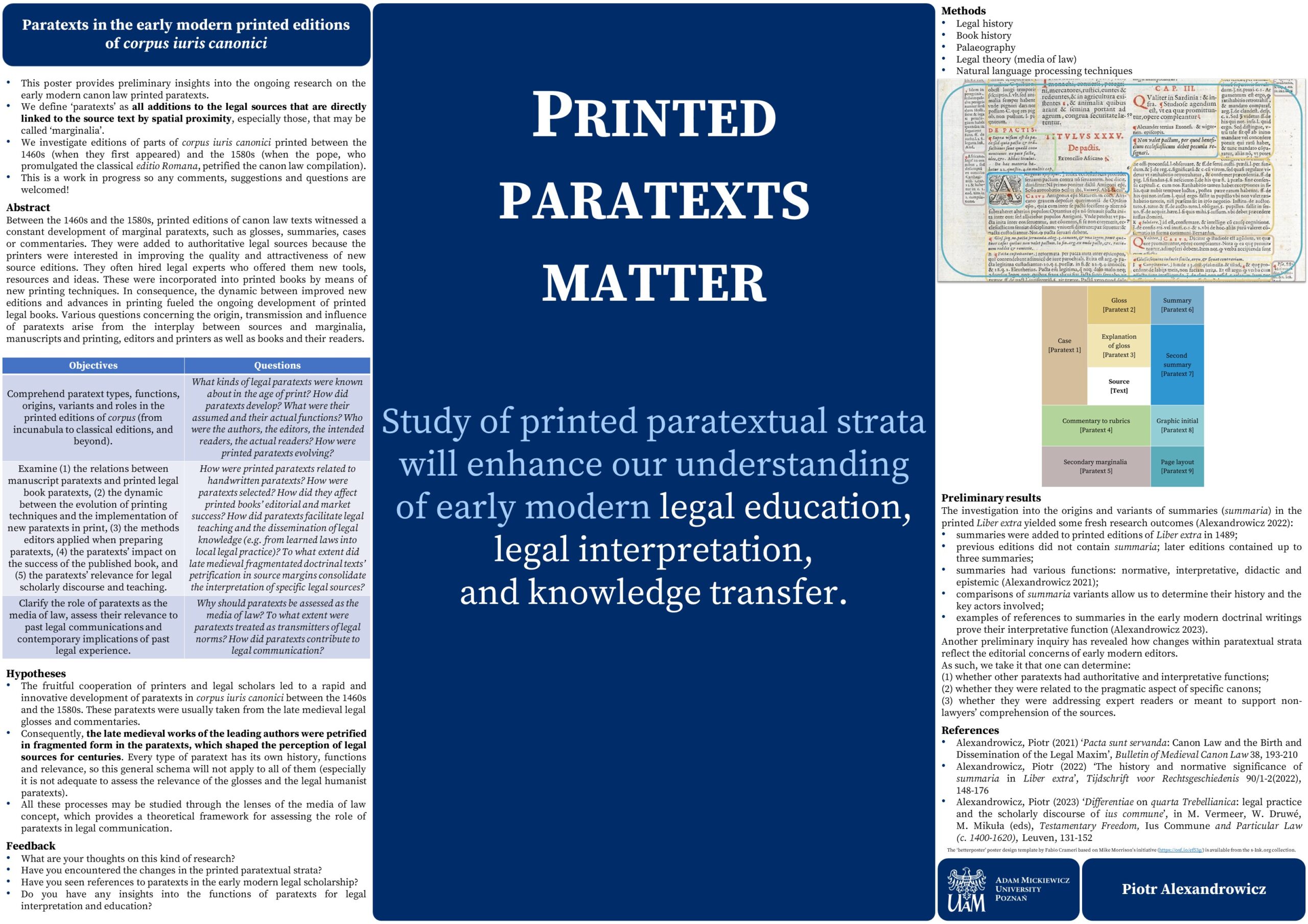
During the XXX Congress of Historians of Law, State, and Political and Legal Doctrines, Cultural Diversity from the Perspective of Legal History, held at our Faculty in Poznań on 15-16 September 2025, Piotr Alexandrowicz presented the concept of the PetrIUS project in the form of a poster similar to the one displayed below. See also the short introduction here: YouTube.
1.09.2025: PetrIUS Kick-off!
The first of September marked the official start of the PetrIUS project.
1.08.2025: Launch of the Centre for Ius Commune
From this date, the establishment of the new unit at AMU officially took effect, with Piotr Alexandrowicz serving as its Director. Administrative support for both the Centre and the PetrIUS project is provided by Karolina Pełka-Gawlik.
The Centre is based in the Collegium Rubrum of the Faculty of Law and Administration at AMU. This building, constructed in 1904, originally served as a Prussian artillery magazine and was later used as military barracks. Following a comprehensive renovation completed in 2024, it now serves as the Faculty’s main seat.
Behind its historic walls, Collegium Rubrum offers a modern working environment equipped with all the facilities needed for research and collaboration. In addition to well-designed office space, the building features shared common areas, a staff kitchen, air conditioning, and other amenities that make it an excellent place to work. It provides the perfect home for our research team.
The Centre for Ius Commune was created to support the implementation of PetrIUS with a high degree of flexibility and autonomy. The Centre will also host events related both to our ongoing research and to broader topics concerning late medieval and early modern ius commune. If there is any connection between your research or activities and our work, we would be delighted to collaborate with you.

Below you can find materials presenting the project. More information will be provided on the new website soon.